Part One: The Walls of San Pedro
In the small town of San Pedro de las Flores, in the state of Jalisco, the houses weren’t grand, but they were rich with memories. They featured walls of sun-dried clay, courtyards draped in vibrant bougainvillea, and long corridors where the afternoon sun would linger. In one of those homes lived Doña Teresa Gomez, a woman who had spent her entire life in tireless labor, as if fatigue were a luxury she simply couldn’t afford.
That house was never silent. It knew the sounds of laughter, celebrations, and those golden Sundays filled with the aroma of rich stews and fresh tortillas. It was there that her son, Miguel, grew up as an only child, raised with the unwavering belief that education was the only true legacy his mother could leave him.
Doña Teresa sold her jewelry, pawned her memories, and accepted the kind of work no one else wanted. When Miguel finally graduated and secured a position in Guadalajara, she felt that every sacrifice had been worth it.
One day, Miguel returned with his wife, Adriana. She was an elegant young woman with polite words and a practiced smile. At first, Doña Teresa welcomed her like a daughter. She taught her how to cook, gave up the master bedroom to the couple, and tended to every small detail to ensure the new bride felt truly at home. She told her without hesitation: “This is your home.”
But time has a restless way of uncovering what is hidden. One night, after Miguel had fallen asleep, Adriana remarked, “The house is far too small for everyone.”
Doña Teresa looked at her, unable to comprehend. The house had three rooms, a wide hallway, and a spacious courtyard. Yet, she remained silent; she was never a woman prone to argument.
Before long, Adriana began rearranging furniture, closing doors, and altering the daily routine. Doña Teresa’s room started filling with “temporary” boxes. Then came the comments: “There is no room for another bed here.” “You sleep very little anyway, don’t you?” “The hallway is breezy; it’s better for sleeping.”
On the first night she slept in the corridor, Doña Teresa lay on an old wooden frame. The roof shielded her from the rain, but it could not protect her from the cold—nor from the indignity. She could hear the laughter from inside, the sound of the television, and the footsteps of those who held the right to sleep in a proper bed. She said nothing.
Miguel traveled frequently for work. Whenever he was home, Adriana would smile, embrace him in front of others, and serve his meals with great care. Meanwhile, Doña Teresa continued to sleep outside. “It’s only temporary until we organize a few things,” the daughter-in-law would say. And Miguel, exhausted and trusting, never asked further.
Years passed. The neighbors would see the elderly woman sweeping the courtyard at dawn and preparing coffee for everyone, only to arrange her bed in the hallway when night fell. Some whispered in disapproval, others felt a quiet rage, but no one dared to step in. “It’s a family matter,” they would say.
Doña Teresa fell ill many times—bouts of flu, aching bones, and feverish nights without enough blankets. Yet, she never complained. When someone asked why she slept outside, she would offer a weary smile and say: “I am fine. I am not bothering anyone.”
As for Adriana, she felt more like the absolute mistress of the house with every passing day. She made the decisions, changed the locks, and spoke of selling, renovating, and of “her” home. All the while, Miguel remained distant and reassured, believing everything was as it should be.
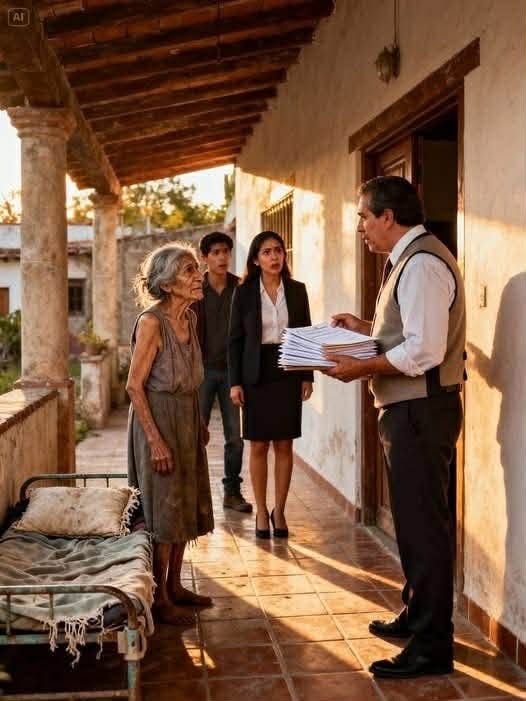
Until one day, without any warning, a lawyer arrived. He was a man in a simple suit, carrying a briefcase with a steady gaze. He knocked on the door mid-morning. Adriana opened it, her face clouding with annoyance. “What do you want?” she asked. “I am looking for Mrs. Teresa Gomez,” he replied.
Adriana frowned. “No lady by that name lives here.” From the corridor, Doña Teresa heard her name. She rose slowly and appeared at the entrance. “I am she,” she said quietly.
The lawyer greeted her with genuine respect, like someone standing before history rather than just a woman. In a calm voice, he said: “I have come to deliver some documents and to inform you of a pending legal proceeding regarding this property.”
Adriana hadn’t expected this. She froze for a moment, then let out a short, tense laugh—a desperate attempt to deflect a growing threat. Crossing her arms, she said, “There must be a mistake. This house belongs to my husband. We have lived here for years.”
The lawyer opened his leather briefcase slowly, as if giving his words time to settle. He arranged the papers with care and spoke in a tone devoid of emotion: “According to the official land registry, this house has been registered in the name of Mrs. Teresa Gomez for over thirty years. There has never been a transfer or surrender of ownership.”
Silence fell like a heavy stone. It wasn’t an ordinary silence, but a revealing one—the kind that forces things to appear exactly as they are. Adriana turned pale, taking a step back. The air seemed to vanish from the room. “This… this is impossible,” she stammered. “We live here. We renovated. We spent money. We planned everything.”
The lawyer looked up at her, his voice firm. “Residency does not equal ownership. Investment does not grant a right. Mrs. Teresa never signed away this property, nor did she sign any deed of sale or authorization.”
In that moment, Adriana no longer saw the lawyer or the papers. She saw years of her life suddenly being rewritten. She saw herself changing the locks. Moving the bed out. Pointing to the hallway. Saying the house was too small. And for the first time, she saw the elderly woman not as a burden, but as the rightful owner of everything.
Miguel arrived that same evening. He entered the house with hesitant steps, sensing the ground beneath him was no longer stable. He listened to the full explanation. He didn’t interrupt. He took the documents and read the names, the dates, and the seals.
Then, he slowly raised his head. He didn’t look at his wife. He looked toward the corridor. To the corner he had stopped noticing. To the small wooden bed. To the worn blankets folded with care. To the place that existed without ever truly being seen.
His voice was broken, the words seemingly hurting him as they left his lips: “Mother… how long have you been sleeping out here?”
Doña Teresa lowered her head. It wasn’t out of shame, but an old habit. The habit of silence. She spoke in a calm voice, free of any bitterness: “For a long time, my son. It’s alright. I got used to it.”
The words “I got used to it” hit Miguel like a physical blow. He stepped back, covering his face, unable to hold back the tears. He wept not like a child, but like a man who realized too late that he had been absent when he was needed most.
Adriana tried to speak. She made excuses. She explained. She said it wasn’t intentional, that circumstances had forced it, that Doña Teresa had never objected. But her words were weak and hollow, finding no ear to listen.
The lawyer remained clear and decisive, leaving no room for ambiguity. He brought years of uncertainty to an end with a few final, undeniable words: Doña Teresa holds the full legal right to the house. The power of decision belongs to her alone.