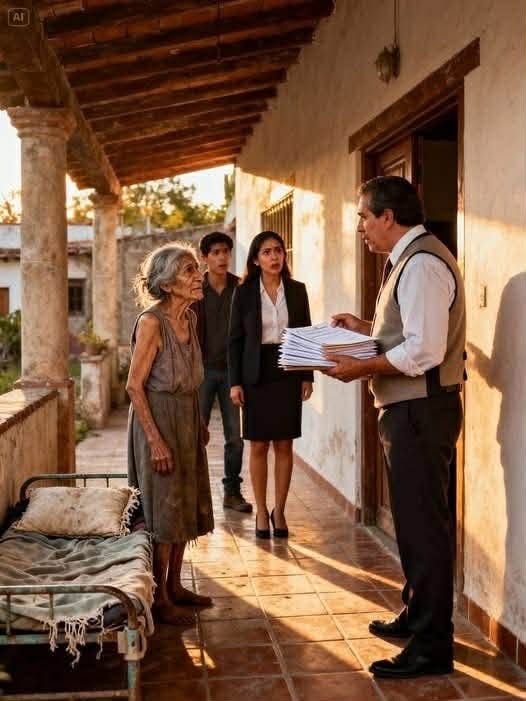
Part Two: The Strength of Silence
She now held the power to choose who stayed and who left. She could sell, vacate, change the locks, or rearrange the very walls as she pleased. The house was hers, the decision was hers, and the authority rested solely in her hands.
Yet, Doña Teresa felt no need to say a word. She did not lift her head in pride, nor did she display a sense of relief. She stood her ground as if the truth hadn’t surprised her, but rather confirmed what she had known through a long, endured silence.
That night, she did not sleep in the corridor. When Miguel insisted she return to her old room, she didn’t answer immediately. She stood at the threshold, looking at the walls that had shared a lifetime with her. He reached out and helped her arrange the bed, as if he were slowly restoring a right that had been stolen from her. He reopened the window, letting in the night air—cool, pure, and smelling like a late apology. Then, he closed the door with extreme gentleness, as if closing a wound that had bled unseen for years.
Doña Teresa sat on the bed for a long time. She didn’t fall asleep right away. She heard the familiar sounds of the house, but this time, they weren’t the sounds of exclusion; they were ordinary, natural, and no longer frightening. She reached for the blanket, and her hand did not tremble.
Meanwhile, Adriana remained in the living room. She sat with a rigid back, trying to cling to the fragments of the image she once believed about herself. She didn’t speak. She didn’t cry. She didn’t ask for an explanation. This time, silence wasn’t a choice; it was a mute admission of defeat.
The following day, she began to pack. It wasn’t a complete clearing out, but a careful selection. She left many things behind—some because they no longer meant anything to her, and others because she realized too late they had never truly been hers. She left for her sister’s house, knowing deep down that what had shattered wasn’t just a passing disagreement, but her entire self-image—one built on an authority she never actually possessed.
Days passed, then weeks. Doña Teresa didn’t change much. She didn’t become harsh, nor did her tone shift. She remained as she was: quiet, soft-spoken, yet heavy with meaning. Her decision wasn’t born of anger or a delayed reaction; it was the sum of a lifetime of patience and a deep understanding of what dignity means when tested in silence.
She acted without noise, just as real things do when they reach maturity. She didn’t slam doors or brandish her power. She never reminded anyone of what she suffered during those freezing nights, nor how many times she slept outside her own walls, smiling just so she wouldn’t burden her son’s heart. She didn’t cast anyone out for revenge, for revenge would have made her exactly what she never wanted to be. She didn’t raise her voice because loud words weren’t her language. And she didn’t count the years spent in the hallway; counting doesn’t heal pain—it only roots it deeper.
She spoke only in a voice that was uniquely hers—the voice of a woman who had lived long enough to know that true strength doesn’t need to scream: “A home is meant to be lived in with peace, not to be a reason for someone’s pain.”
The sentence was simple on the surface, but it carried the weight of decades. It wasn’t a justification or an accusation; it was a clear line between what is acceptable and what is not. She set her conditions as values are set—non-negotiable and beyond compromise:
-
Respect: Not a passing politeness shown in public and forgotten behind closed doors.
-
Dignity: Not a pity that humbles the receiver more than it saves them.
-
Honesty: Not a comfortable silence that hides injustice and lets it grow in the shadows.
She didn’t ask for an apology. She didn’t wait for a public display of regret. She was content simply to see things returned to their rightful places. Miguel agreed without hesitation, but his agreement this time wasn’t just words. It was a longer gaze, a heavier silence, and a different kind of presence—as if he had returned home for the first time with his eyes wide open. He stopped looking for comforting excuses and stopped avoiding the questions he once feared. He began to see the small details he had ignored, understanding that “absence” isn’t always a journey; sometimes, it is a silent neglect.
For Adriana, the truth was too heavy to bear. The mirror no longer reflected the person she wanted to see. She could no longer see the confident, composed woman who justified everything in the name of necessity or “the way things are.” The reflection was now honest—too honest to endure. It was a face full of questions, eyes that fled from confrontation, and a silence that exposed what words had long hidden. Explanations were useless now; when words come too late, they lose their meaning. When truth finally appears, it does not argue.
Departure was the final option—not just an escape, but a withdrawal from a confrontation that would have forced her to see herself as she truly was, not as she pretended to be. It was a confrontation she wasn’t ready for and didn’t have the courage to survive.
With her departure, the corridor returned to what it once was. Not suddenly, but slowly, like breathing again after a long suffocation. It was as if the place itself had been waiting, enduring until it could return to its original nature. It filled with the plants Doña Teresa loved—plants that don’t bloom quickly but do not die easily. They are plants that know patience and understand the meaning of growing a little every day in silence, without asking for recognition or applause.
The hallway filled with wooden chairs that knew exactly where to sit with the sun, welcoming the light when it came and settling for the shade when the day grew long, without complaint. Light began to enter the corridor without fear, without permission, and without apology. It entered as it always had, before it was forbidden and narrowed in the name of “order.”
The wooden bed disappeared—the silent witness to long nights where no one heard a groan or saw a shiver of cold. The physical frame was gone, but its trace remained. Houses do not forget, even when they are repainted, even when the scent of the air changes, and even when the furniture is replaced. The walls hold the whispers, the floors remember the footsteps, and the corridors keep what passed through them more than one might think. Some places hold onto memories not to haunt their owners, but to remind them that they stood firm when standing was the only choice—and that they survived, even if survival came late.
Every evening, Doña Teresa sits there. She doesn’t rush to sit, nor does she hurry to find a comfortable position. She sits as one who no longer fears time or place. She holds her cup of hot coffee with hands that learned patience more than they learned complaint—hands that worked long and endured more than was ever said or known.
She watches the sun slowly retreat from the walls that were always hers—even on the days she wasn’t allowed to claim them, even in the moments she felt like a stranger in her own home. She feels no hatred, for hatred keeps the wound open and steals what remains of the heart’s peace. She feels no sense of triumph, for victory was never her goal; she wasn’t looking for conquest, only for simple justice and a safe place.
She feels only a quiet sadness. A sadness that doesn’t hurt, but reminds. It is a sadness like the scent of rain after a long drought—it doesn’t drown the earth, but it leaves a fragrance that is never forgotten. She feels a late tranquility, a peace that came after putting everything in its right place, after everything regained its true name, and everyone found their clear boundary.
It is a steady, unshakable certainty—the certainty of a woman who knew, after a whole lifetime, that silence is not always weakness, and speaking is not always courage. True strength can be found in waiting, and in choosing the exact moment when the truth is told without a scream.
For there is a silence that pains when it is forced—when it is used to mute the truth and let injustice stretch in the shadows. But there is a silence that heals when it is chosen—when it is a conscious decision and a path to preserving dignity rather than burying it.
And there are houses that may wait a long time, may endure more than they should, and may bear the unbearable. But no matter how much time passes, no matter how many faces come and go, and no matter how the voices change—the house must, one day, tell the truth.