He paused for a moment, then traveled there with Clara.
The village was small, cradled by green hills where the air carried the scent of rain and earth. Among the simple stalls, Clara saw a face she would never forget: a man in his mid-thirties with a light beard and humble clothes, painting a young girl’s portrait with a gentle, kind smile.
She cried out instinctively, “Daniel!”
He raised his head and froze. His eyes shimmered with wonder and confusion, like someone seeing a ghost from his past. “I know you from the orphanage… Clara!”
Arthur approached him, his voice trembling. “Lucas…”
The man stopped, looking between them with tension, as if trying to gather the scattered fragments of a lost memory. Arthur pulled the old drawing from his pocket—the one found at the orphanage—and said, “Do you remember this? You drew it when you were little. You wrote on it: My brother will find me one day.“
When his eyes fell upon the drawing, it was as if something inside him broke and then swung wide open. Tears fell suddenly as he held the paper with a shaking hand, his voice breaking. “I used to see this house in my dreams… the piano… my brother… I thought it was just a fantasy.”
Arthur stepped forward and embraced him tightly. His voice was choked with emotion as he whispered into his ear, “I never stopped looking for you, Lucas. I never gave up.”
Clara stood beside them, weeping in silence. The scene felt like the restoration of a stolen life, returned in a single moment.
Lucas returned to the manor weeks later. At first, he was fearful and silent, as if his memories were hiding behind a thick fog. He sat before the old piano and ran his fingers over the keys; a soft note resonated—a melody he used to play as a child. In that moment, he broke down in tears.
Slowly, the memories began to return: his mother’s face, his father’s laughter, his older brother’s promise. He didn’t recover everything, but his heart remembered what his memory could not put into words.
When Arthur discovered the full truth, the revelation was even more profound. The woman who had handed Lucas over to the orphanage was a nurse paid by a wealthy family to facilitate an illegal adoption, but she had died in an accident a year later, leaving the child alone once again. A chain of errors and selfishness had created a tragedy spanning three decades.
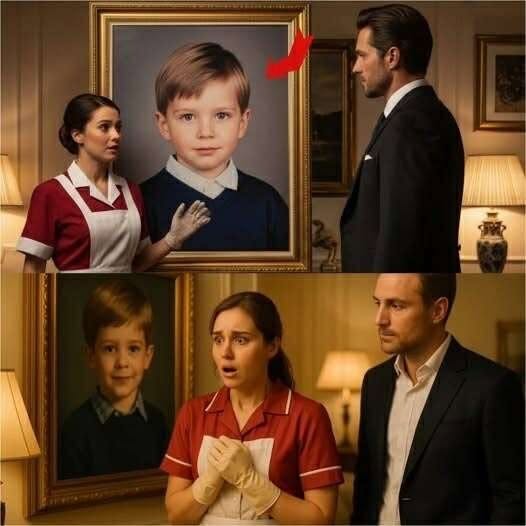
But Arthur did not want the story to remain a tragedy. Standing before his brother’s portrait, he said, “I won’t let what happened be in vain.”
From that moment, the Menezes Foundation was born—an organization dedicated to helping missing children, funding orphanages, and searching for forgotten families. He appointed Clara as the foundation’s director and had Lucas design its logo himself.
He drew two young boys holding hands in front of a piano—the same drawing that had been the beginning of the end, and the start of a new life.
At the opening ceremony, Arthur stood on the platform before the audience and spoke with deep emotion: “This story began with a promise made by a child to his brother, and it reached a woman who kept a memory that saved two lives. Today, we turn pain into hope, and loss into a path that leads to reunion.”
Then he turned to Lucas, who approached and embraced him before everyone, saying in a low voice: “Love found us, Arthur… even after all this time.”
The audience applauded warmly, but the silence in their hearts was more profound than any cheering. Clara looked at the painting hanging on the wall—the one where the story began—and smiled. The eyes in the portrait seemed to shimmer as if they were smiling too.
That evening, Arthur went out into the garden and looked up at the clear sky. He stood beside his brother, who asked quietly, “Do you think we are too late?”
Arthur smiled and replied, “A brother never arrives too late, Lucas. He arrives exactly when he can bring peace back to the heart.”
In the silence of the night, with the breath of the wind, the three of them—Arthur, Lucas, and Clara—felt that the past had finally placed its hand in the hand of forgiveness, and that some stories do not end with tears, but rather begin with them.